 Concave
 staking rewards and dilution in the 2022 model
Concave linked larger staking reward boosts to longer commitments in its March 2022 launch model. The design capped entry to the longest, 12-month liquid staking category and attached specific anti-dilution treatment to those positions. Shorter terms received smaller boosts. Rewards also included a treasury-dividend component whose amount depended on the staking term. A holder’s share of CNV supply depended on how their balance grew relative to total supply.
Updated:
In short: The 2022 design distinguished an immediate staking reward from redemption at the end of the chosen term.
Reward boosts across staking terms
Term length determined the relative reward boost in the launch design, with the largest boost assigned to the longest liquid staking position. The shortest category received the lowest boost. This established an ordering between categories, without making the duration itself a numerical yield quote.
The 12-month category combined the longest commitment with special dilution treatment and restricted entry. Shorter terms reduced the duration of the commitment and carried smaller reward boosts.
How did the longest position limit dilution?
The 2022 design tied non-dilution for the longest staking category to a limit on non-dilutive positions and a minimum bond price.
Capped entry to non-dilutive positions
The model restricted how many stakers could enter the longest category. Willingness to commit for 12 months therefore did not establish unrestricted access to that category.
Short-term stakers faced dilution under the launch design. The launch design explicitly favored long commitments, so the longest category’s protection should not be applied to every staking position.
A minimum bond price
The pricing condition concerned bonds, while its anti-dilution benefit concerned the longest-term stakers. This connected treasury funding with the treatment of existing positions. Bonding and staking remained distinct operations, even though their economic effects interacted within the model.
Reward recognition and term-end redemption
The model described an immediate, compounded reward upon staking, with redemption at the end of the user’s term. Recognizing a reward at entry did not make the position mature at entry.
Treasury income alongside token rewards
Treasury dividends added an investment-income component to the staking model, and their amounts depended on the staking term. The treasury-management component aimed to generate income by investing assets across strategies and product lines. This gave dividends a different economic basis from token emissions. A term-weighted reward boost described one part of a position’s benefits. It did not, by itself, determine the separate dividend amount or establish the return that treasury investments would generate.
A higher CNV balance with a smaller supply share
A growing CNV balance can still lose supply share when issuance expands supply faster. In this hypothetical comparison, a holding increases from 142 to 150 CNV, while total supply increases from 14,200 to 15,620 CNV. All balance and supply figures belong to this example.
A larger holding after issuance
The holding initially represents 1% of supply: 142 divided by 14,200. After both increases, 150 divided by 15,620 gives approximately 0.9603%. The holding contains eight additional CNV, yet its fraction of supply has decreased.
Preserving the original supply share
A holding of 156.2 CNV would represent 1% of the larger, 15,620 CNV supply. That is 14.2 CNV above the initial 142 CNV, or 6.2 CNV above the hypothetical ending balance of 150 CNV. Both the holding and total supply would have grown by 10% in that case.
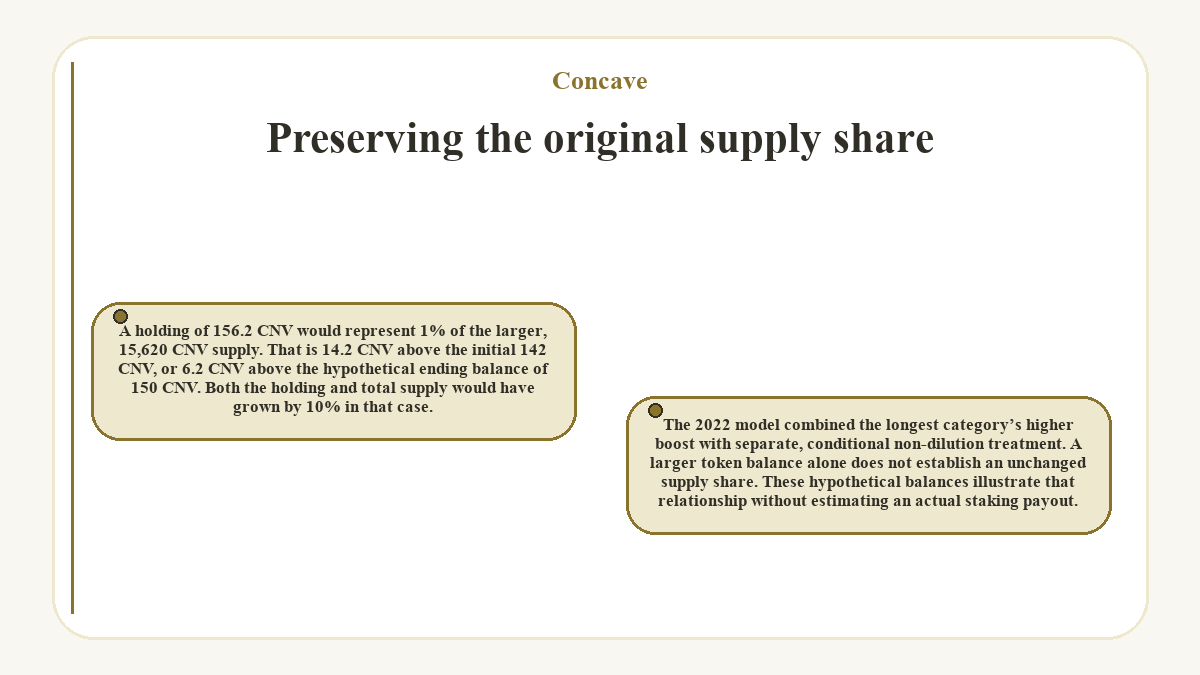
The 2022 model combined the longest category’s higher boost with separate, conditional non-dilution treatment. A larger token balance alone does not establish an unchanged supply share. These hypothetical balances illustrate that relationship without estimating an actual staking payout.
Unminted rewards and backing per CNV
The launch model also described an excess reward rate variable that controlled excess, unminted rewards. It connected this control with its aims for price stability and greater treasury backing per CNV. This was another part of reward policy alongside the boost linked to term length.
Backing per token concerned treasury assets in relation to CNV supply. A larger token reward and greater backing per token described different outcomes. Increasing a position’s token count alone did not establish that the treasury held more assets per CNV.
NFT positions and a proposed exit route
The March 30, 2022 launch announcement proposed a secondary marketplace for individual liquid staking positions represented by NFTs. The proposed trade concerned ownership of a position, whose staking term still mattered.
This gave the word liquid a specific context: the design contemplated trading the position before its underlying reward became redeemable. A secondary sale would require a buyer and an agreed price. That route differed from waiting for the term-end redemption mechanism.
Did a longer term specify a fixed APY?
A longer term specified a higher relative reward boost in the 2022 design, without establishing a fixed annual percentage yield (APY) from duration alone.
A numerical yield would require the starting stake, applicable reward amount, and timing, together with any compounding assumptions. The phrase compounded reward did not provide those inputs by itself. Treasury dividends also had their own amounts and distribution timing, so a staking boost could not stand in for the whole return.
Duration and the value of an eventual exit
The longest category combined stronger reward treatment with a longer commitment and restricted entry. A shorter term reduced that commitment while accepting the design’s lower boost and different dilution treatment.
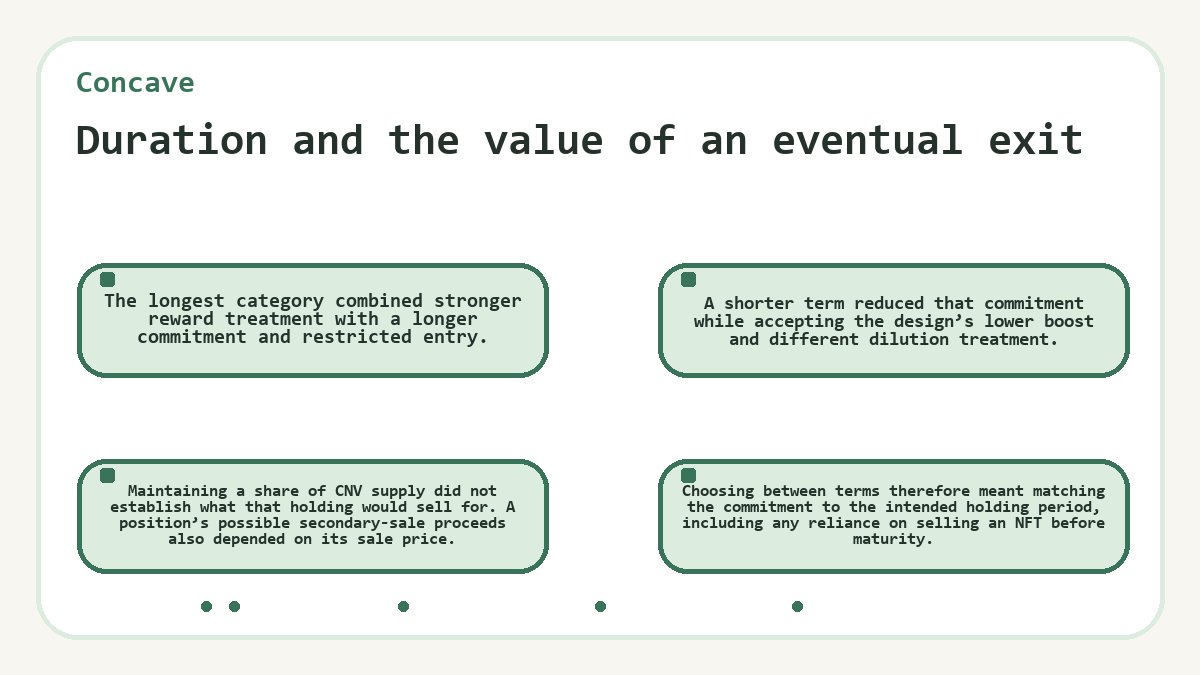
Maintaining a share of CNV supply did not establish what that holding would sell for. A position’s possible secondary-sale proceeds also depended on its sale price. Choosing between terms therefore meant matching the commitment to the intended holding period, including any reliance on selling an NFT before maturity.
Everyday questions about Concave
Were treasury dividends scheduled only at staking maturity?
The 2022 model described treasury dividends at predefined intervals, separately from the staking reward redeemable at term end. The staking term influenced the dividend amount, while the distribution interval governed its timing. A position’s maturity date alone did not establish its dividend schedule.
Did the minimum bond price guarantee a CNV resale price?
The minimum bond price belonged to the bonding conditions supporting the longest position’s anti-dilution treatment. It did not establish a guaranteed price for selling CNV on a secondary market. Bond pricing, treasury backing per token, and a holder’s market sale price described different relationships.
How did bond optimization relate to the 2022 staking model?
The off-chain bond optimizer aimed to maximize treasury value relative to token supply. That objective connected treasury growth with the model’s treatment of staker dilution.
Why did the 2022 model favor longer staking commitments?
Higher reward boosts and conditional non-dilution treatment were intended to encourage longer commitments while attracting bond revenue. These incentives addressed the tension between growing the treasury through bonding and preserving benefits for long-term stakers.