 Concave
 bonding targeted treasury value per CNV in the 2022 launch model
Concave bonding aimed to grow treasury value relative to the supply of CNV, the project’s token. In the March 2022 launch model, an off-chain optimization algorithm pursued that objective. Bond pricing also interacted with the design’s anti-dilution treatment for the longest liquid staking category. A bond buyer needed to assess the CNV acquisition cost and delivery terms separately from the effect on treasury assets and CNV supply. A larger treasury could coexist with unchanged backing per token. These historical design terms did not establish a current bond quote or purchase window.
Updated:
Bonding and swaps addressed different needs
Within the launch design, bonding supplied treasury capital, and liquid staking assigned rewards by commitment length. The application code also documented token-swap functionality. A bond comparison concerned the capital entering the treasury and the supply consequences of that funding. A swap comparison concerned the terms of an exchange. Treating a staking reward as the bond’s purchase return would combine distinct parts of the design.
Off-chain optimization linked funding to supply
Concave’s March 2022 bonding model used an off-chain optimization algorithm. Its intended benefit concerned treasury value relative to supply. Evaluating treasury size alone would leave the supply effect unresolved. Reproducing an individual bond price would require the optimizer’s actual pricing inputs and rules.
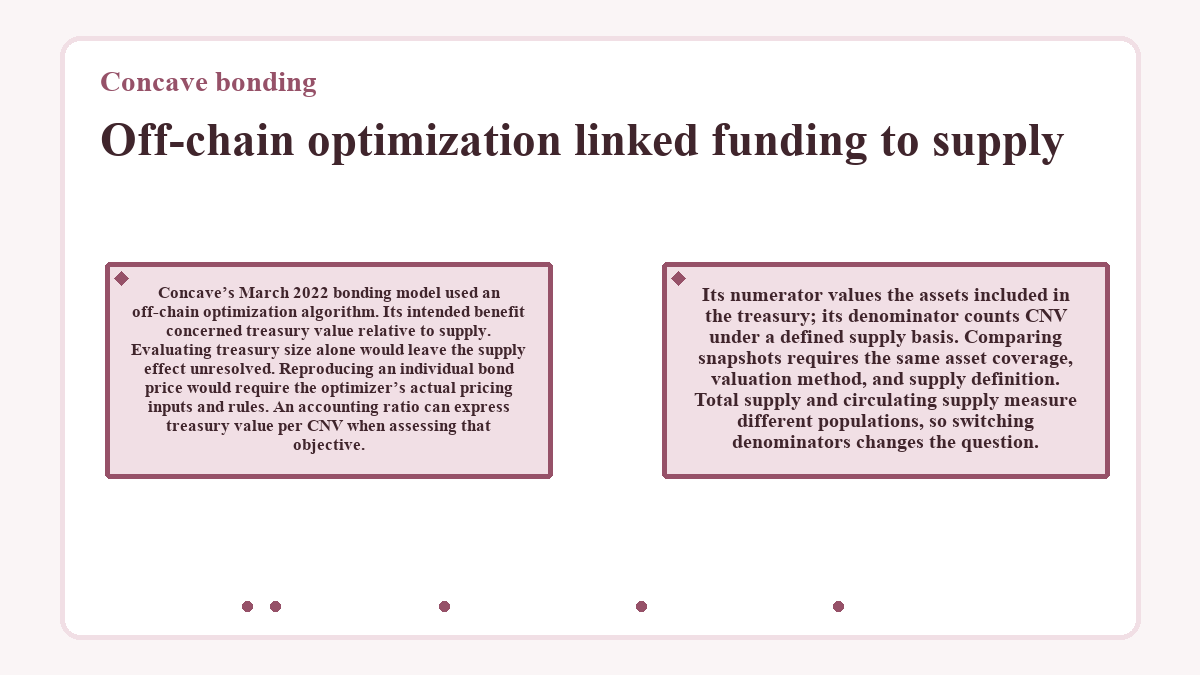
An accounting ratio can express treasury value per CNV when assessing that objective. Its numerator values the assets included in the treasury; its denominator counts CNV under a defined supply basis. Comparing snapshots requires the same asset coverage, valuation method, and supply definition. Total supply and circulating supply measure different populations, so switching denominators changes the question.
A growing treasury could leave backing per CNV unchanged
Consider a hypothetical treasury comparison, with every amount chosen solely for illustration. Starting treasury value is 71,265 valuation units, and total supply is 14,253 CNV; the valuation unit stays constant throughout. Dividing 71,265 by 14,253 gives starting backing of 5 valuation units per CNV.
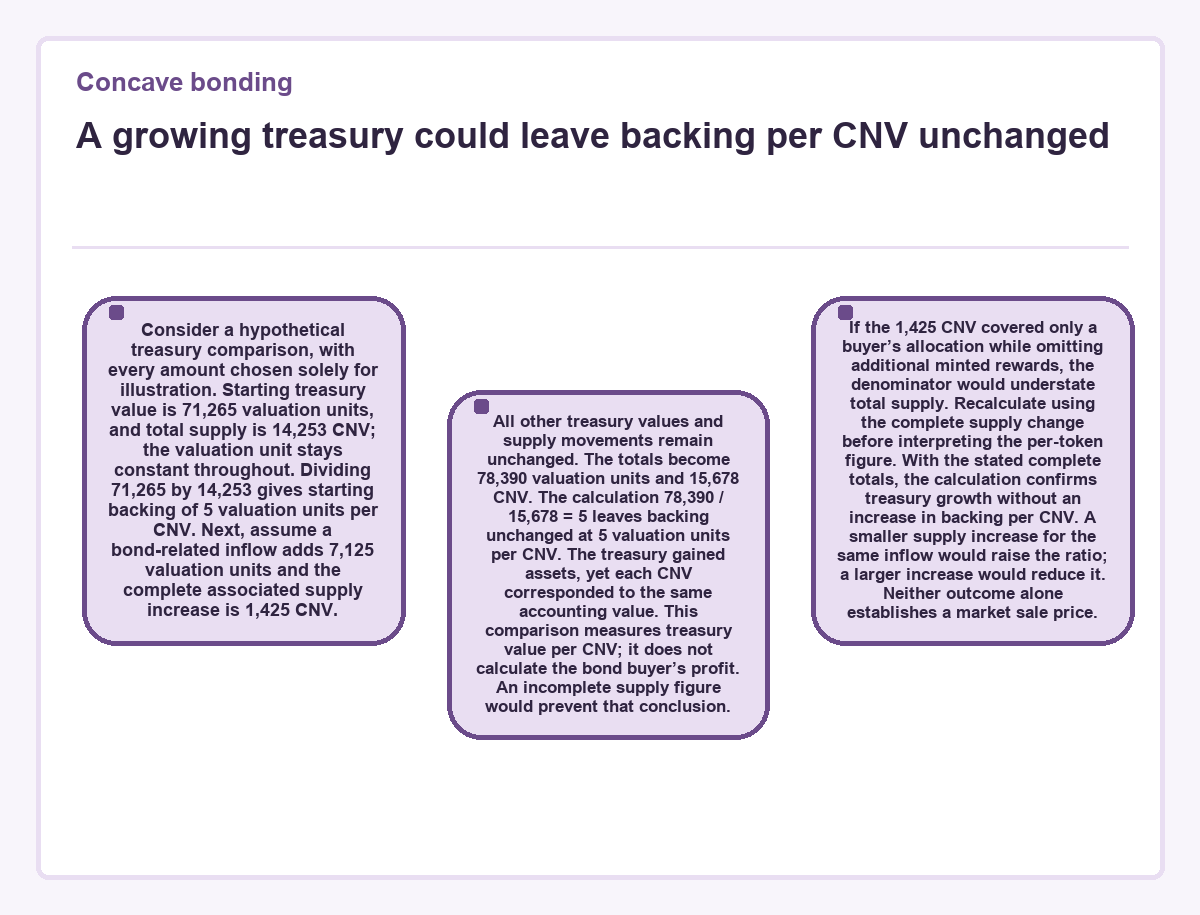
Next, assume a bond-related inflow adds 7,125 valuation units and the complete associated supply increase is 1,425 CNV. All other treasury values and supply movements remain unchanged. The totals become 78,390 valuation units and 15,678 CNV.
The calculation
78,390 / 15,678 = 5
leaves backing unchanged at 5 valuation units per CNV. The treasury gained assets, yet each CNV corresponded to the same accounting value. This comparison measures treasury value per CNV; it does not calculate the bond buyer’s profit.
An incomplete supply figure would prevent that conclusion. If the 1,425 CNV covered only a buyer’s allocation while omitting additional minted rewards, the denominator would understate total supply. Recalculate using the complete supply change before interpreting the per-token figure.
With the stated complete totals, the calculation confirms treasury growth without an increase in backing per CNV. A smaller supply increase for the same inflow would raise the ratio; a larger increase would reduce it. Neither outcome alone establishes a market sale price.
A price floor supported a limited staking category
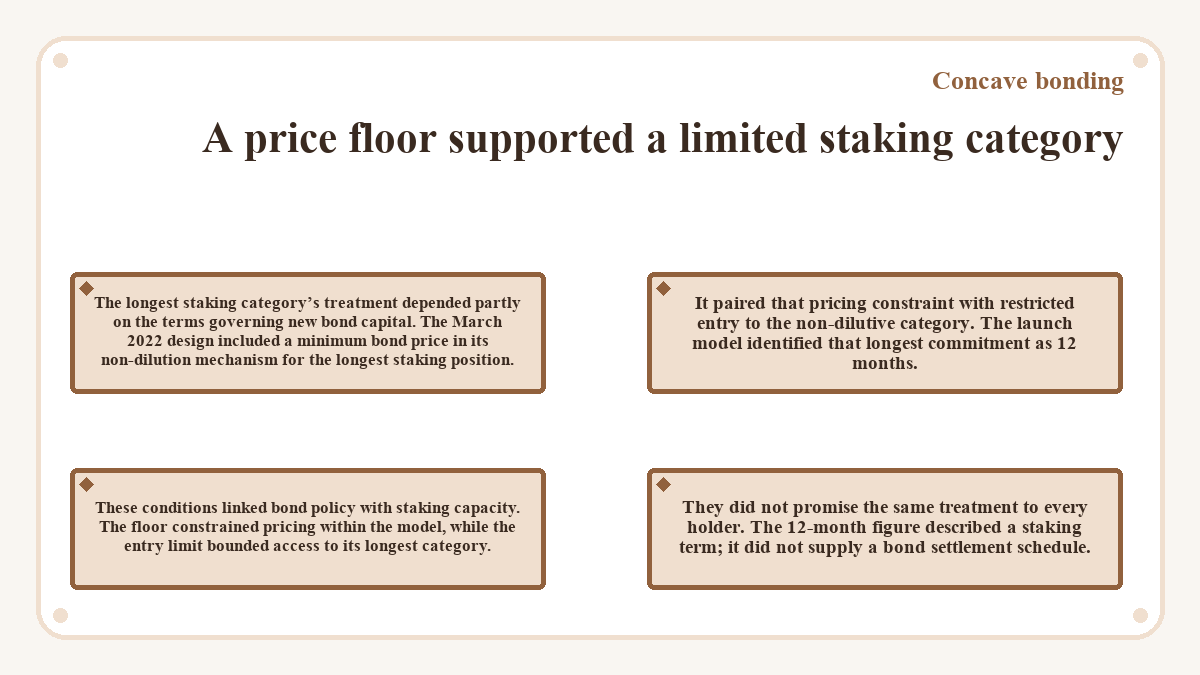
The longest staking category’s treatment depended partly on the terms governing new bond capital. The March 2022 design included a minimum bond price in its non-dilution mechanism for the longest staking position. It paired that pricing constraint with restricted entry to the non-dilutive category. The launch model identified that longest commitment as 12 months.
These conditions linked bond policy with staking capacity. The floor constrained pricing within the model, while the entry limit bounded access to its longest category. They did not promise the same treatment to every holder. The 12-month figure described a staking term; it did not supply a bond settlement schedule.
Bond revenue differed from treasury investment returns
After capital entered the treasury, investment management addressed a separate source of returns. The 2022 model described investment portfolios and dividends whose amounts depended on staking duration. Bond proceeds represented funding; dividends represented distributions from managed treasury activity. A larger inflow therefore could not stand in for realized investment earnings. Assessing the funding objective required the treasury-to-supply relationship, while assessing dividends required the applicable staking terms and distributable investment returns.
Purchase economics depended on the bond offer
At the purchase level, cost had to be measured against the CNV entitlement and its timing. A useful comparison would value the input asset amount and any additional purchase costs in the same unit, then add them. Dividing that cost by the CNV entitlement would give an acquisition cost per token. Delivery restrictions would affect when that amount could serve the buyer’s purpose. The treasury-wide ratio answers a different question and cannot replace these offer-specific inputs.
Present bond availability and settlement terms remain unconfirmed. Accepted assets, networks, costs, and delivery conditions require offer-specific terms. The historical announcement scheduled the public launch for 31 March 2022.
Concave bonding: common questions
-
Was every Concave bond offered at a fixed discount?
- The 2022 bonding objective did not define a fixed discount for every purchase. A discount comparison would require both the bond acquisition price and a comparable CNV market price, expressed on the same basis. The optimization objective alone supplied no discount percentage.
-
Could the optimizer guarantee a profitable Concave bond purchase?
- An off-chain optimization objective did not establish a profitable outcome for an individual bond buyer. Treasury efficiency and personal investment returns measured different things. A buyer’s return would also depend on acquisition costs, delivery terms, and the value obtainable on sale.
-
Did a Concave bond promise principal repayment and a coupon?
- The March 2022 description presented bonding as treasury funding linked to CNV supply. It did not establish a loan contract with principal repayment and a fixed coupon.
-
Which excess rewards affected the supply side of CNV backing?
- The 2022 model used an excess reward rate variable to control rewards that remained unminted. Unminted rewards had not increased issued CNV supply. That distinction mattered when measuring backing: potential rewards and tokens already issued belonged to different supply states.
-
Can backing per CNV be read as a treasury redemption quote?
- An accounting ratio does not by itself establish a right to redeem CNV for treasury assets. A redemption amount requires an applicable redemption mechanism and its terms. Treasury value divided by token supply describes the asset value assigned to each token under that calculation.